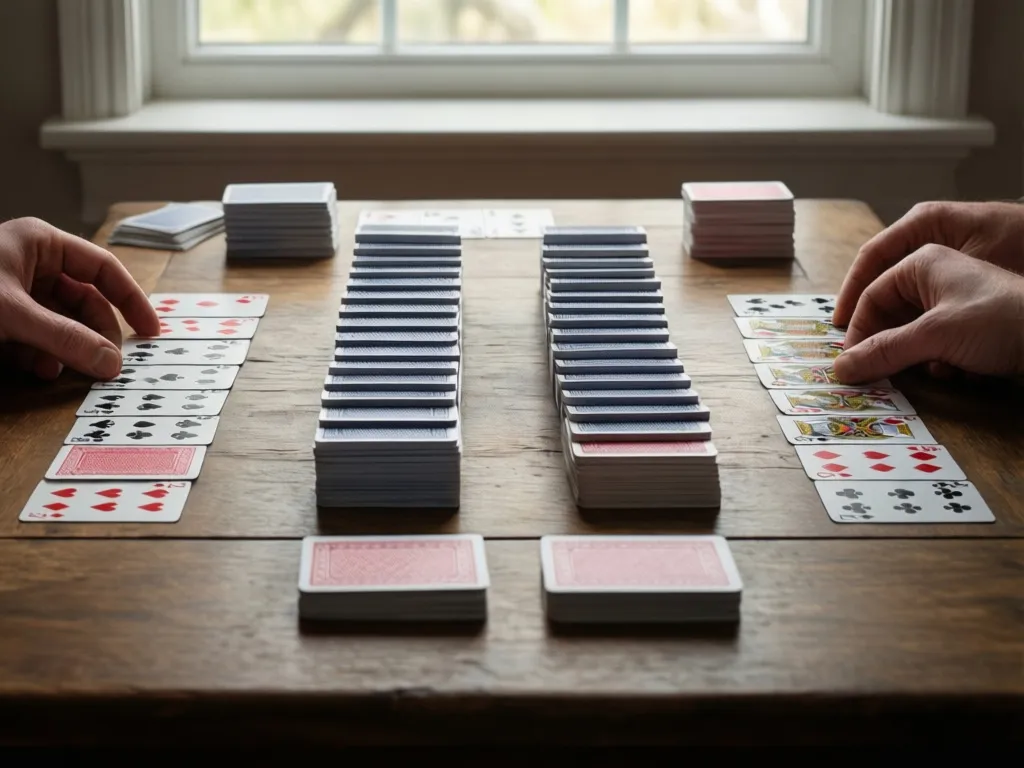
Double Solitaire Klondike combines two Klondike boards on a single screen. This variant uses two decks and, depending on the platform, may feature two independent stock piles or a shared stock. The goal is to complete both foundations on each board, typically building from Ace to King in each suit. The result is a more demanding, more rewarding puzzle that tests planning, multi-front management, and pattern recognition across two fronts.
Read also: Klondike Solitaire Play: Master the Classic Card Game Today
What is Double Solitaire Klondike?
In Double Klondike, players work two traditional Klondike boards side by side. Each board has its own tableau, stock, waste, and foundations. Because there are two decks in play, duplicates of every card appear on the board, which changes how you search for moves and how you sequence them. Some online implementations give each board its own stock and waste, while others share a single stock across both boards. In either case, you win when both foundations are completed on both boards.
Two common setups
- Independent boards: Each Klondike board has its own stock and waste, with separate tableau and foundations. Moves are confined to the board they belong to, but you must plan for how moves on one board influence opportunities on the other.
- Shared stock variant: A single stock is used for both boards, with alternating reveals or a shared waste. This increases the interdependence of the boards and often makes early planning crucial.
How Double Klondike differs from standard Klondike
The biggest differences are volume and coordination. Standard Klondike centers on optimizing a single tableau to its foundation. Double Klondike doubles the decision tree: you must maximize potential moves for two boards at once, decide which board to advance when both offer options, and manage stock depletion in a way that benefits both fronts. Expect longer solve times on average, but the payoff is a deeper sense of mastery and greater adaptability for other two-deck variants you might encounter in practice.
Setup and Variants
Setting up Double Klondike typically involves two decks (104 cards total). Key elements to check before you start:
- Seven-column tableau for each board, with the standard descending order and alternating colors.
- Foundations for each board start with Aces and progress to Kings, one foundation per suit per board.
- Stock and waste piles per board (or a shared stock, depending on the variant).
- Visible cards: ensure the top card of each tableau column is face up where possible to unlock future moves.
Variant considerations:
- Independent boards maximize simplicity and predictability; you can treat each board as its own puzzle while still thinking ahead for the other.
- Shared stock increases difficulty but can be more satisfying for players who enjoy tight resource management and cross-board planning.
Strategy Essentials
Core principles
Double Klondike rewards deliberate sequencing. Prioritize moves that open multiple new cards on either board, especially those that free up Aces to Foundations. Manage two fronts by identifying moves that simultaneously strengthen both boards whenever possible.
Plan for both boards
Think in terms of pairs of moves: what you do on Board A should ideally create an opportunity on Board B, and vice versa. Avoid over-committing cards to Foundations too early if that blocks important sequences in the tableau. The best players keep a few flexible moves available in each board until a clear path to a win emerges.
Strategic tips and concrete actions
- Always reveal cards that unlock additional moves in at least one board. If you can uncover a card that unlocks a sequence on either board, prioritize that.
- Keep foundational cards accessible. When a foundation move is possible, verify that it won’t block a critical sequence on the other board.
- Balance stock usage. In independent-board variants, you might cycle through the stock more quickly on one board than the other. Try to pace stock turns so both boards experience regular opportunities to reveal new cards.
- Don’t ignore color and rank patterns. Sequences in the tableau often depend on color alternation; preserving longer, movable sequences can dramatically increase future options.
- Use forced moves strategically. If a card must move to a foundation to avoid a dead end, do it, but only when it does not close off future opportunities on the other board.
Step-by-step Play Example
While every deal is unique, a practical play-through guide helps you apply the ideas above:
- Scan both boards for immediate foundation moves. If any Ace can be placed, do so on its corresponding foundation while ensuring the tableau remains flexible.
- Identify any single-card moves that unlock longer sequences. Execute those before minor shifts that don’t impact future depth.
- If you must choose between two equivalent moves, select the option that preserves the most potential moves on the other board.
- Expose hidden cards by cycling through the stock on the board where it yields the most new face-up cards.
- Periodically reassess both boards together. A move that seemed minor 10 turns ago may unlock a critical chain now.
- Endgame discipline matters: consolidate moves that lead to simultaneous finishes when possible, rather than racing one board to completion at the expense of the other.
Common Pitfalls and How to Avoid Them
- Over-committing to a single board: This leaves the other board stuck in a stagnant phase. Maintain a balanced plan across both boards.
- Ignoring weak tableau columns: Columns with long, blocked sequences can prevent access to high-value cards. Prioritize freeing them when possible.
- Premature stock exhaustion: Wasting too many stock turns on one board can leave the other with insufficient options later on. Plan stock turns with a two-board horizon.
- Forgetting about foundations: It’s easy to delay a foundation move in hopes of a bigger catch. If it’s safe, place ready aces to keep options open elsewhere.
Practice, Resources and Tools
Practice is essential to mastering Double Klondike. Use the following approaches to build skill and confidence:
- Play multiple practice deals on Solitaire Compass to recognize common two-board patterns and winning sequences.
- Review strategy guides for two-deck Klondike variants to learn advanced sequencing and resource management.
- Track your win rate per board configuration to identify which setups you perform best on and adjust your approach accordingly.
Frequently Asked Questions
- What is Double Klondike? A two-deck Klondike variant where two boards are played simultaneously, either with independent or shared stock, aiming to finish both foundations.
- Is Double Klondike harder than standard Klondike? Yes, it adds strategic depth and requires maintaining progress on two fronts, which increases difficulty and reward when you succeed.
- Do I need two decks to play Double Klondike? Most implementations use two decks, but some game modes adapt to single-deck variants with mirrored cards across boards.
- What is the best way to start a two-board game? Look for immediateFoundation moves on either board, then prioritize exposing cards that unlock longer sequences, keeping options available on both boards.
- Can I move cards between boards? In standard setups, moves stay within their own board. Some platforms allow cross-board moves in special modes; follow the platform’s rules.
- Where can I practice Double Klondike? On Solitaire Compass, you can explore practice deals, read strategy guides, and test different stock rules to deepen understanding.