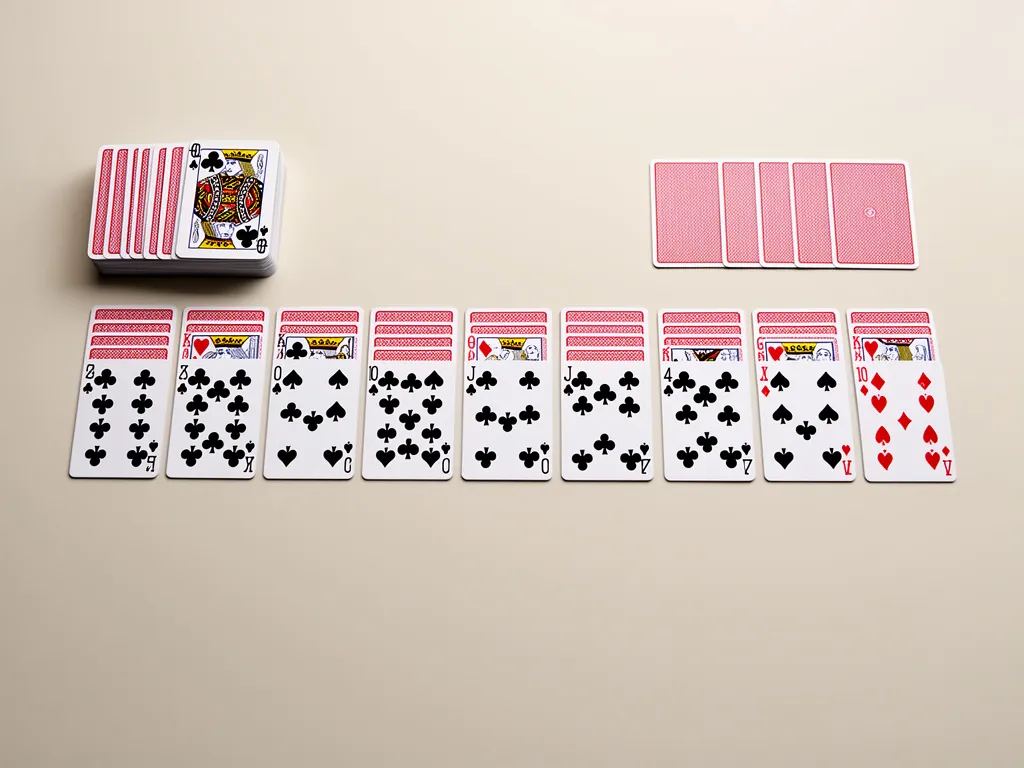
Overview of the Spider solitaire setup layout
Spider Solitaire uses two decks and 10 piles, known as the tableau. At the start each pile receives 5 cards, with four facedown and one face up. This creates 10 visible top cards while leaving 54 cards in the stock for later dealing. The goal is to build complete descending stacks from King to Ace in a single suit, which can then be removed from the tableau to free space and move you toward clearing the board. The fixed tableau and the stock-based deal rhythm define the core setup you will repeatedly manage across games.
Read also: Spider Solitaire Scoring System Master Points in 1 2 and 4 Suit
Initial deal and stock management
Initial deal distributes 5 cards to each of the 10 piles, yielding a total of 50 cards in the tableau. The remaining 54 cards form the stock. You deal cards from the stock in rounds: one card to each pile, typically up to five full rounds, with the last round possibly partial depending on how many cards remain. Effective stock management means reserving moves that unlock long sequences before triggering a new deal. When you can remove a complete run, you free spaces that open up multiple options and often create cascading opportunities in the same suit.
Tip: Some implementations offer auto-build options. In practice, manual sequencing often yields higher win rates, especially in 4-suit games where the layout presents richer blocking and, therefore, more strategic choices. The setup remains the same across modes, but your planning and move selection should adapt to the suit variant you choose.
Setup variations by game mode
1-suit Spider
In 1-suit mode you use a single suit across both decks. Descending runs become simpler and more predictable, so your focus turns to locating long, uninterrupted sequences and preserving them for removal. The initial layout stays 10 piles with five cards per pile, where four are facedown and one is face up. Stock management emphasizes maintaining continuity in that single suit across the board.
2-suit Spider
Two suits of the same color are used in 2-suit mode. This adds variety to runs and allows alternations between suits within a descending stack. The setup mechanics are unchanged, but planning must account for color and suit transitions. Look for opportunities to extend runs across suit boundaries while still preserving long sequences that can be cleared together.
4-suit Spider
In the full 4-suit variant all four suits appear. This is the most challenging setup because suits introduce blocking and more complex blocking chains. The same initial tableau applies, but you must balance exposure of top cards with the need to unlock long sequences that span multiple suits. Patience and multi-move foresight become essential to success.
Practical tips to optimize setup and play
- After each deal, quickly preview the top 10 cards across the tableau to identify potential full-length runs.
- Plan two moves ahead before triggering a deal. The right sequence can unlock a cascade of moves in a single turn.
- Avoid moving a card into a position that blocks a growing run. If a promising chain is forming, protect it rather than breaking it for a minor gain.
- Use the stock judiciously. Dealing too early can create congestion in the late game; reserve deals for when clear progress isn’t obvious.
- In 4-suit mode, prioritize clearing multi-suit blocks and preserving single-suit runs where possible; in 1-suit mode, chase longer uninterrupted stacks and faster clearance.
FAQ
Q: How many cards are dealt to each pile at the start? A: Each of the 10 piles starts with 5 cards, with the top card face up and the rest face down.
Q: How many deals are available from stock? A: You can deal up to five complete rounds of 10 cards, with a possible partial deal on the final pass depending on the remaining stock.
Q: What counts as a completed run? A: A complete run is a descending sequence from King to Ace in the same suit, which can be removed from the tableau.
Q: Can I adjust the layout on Solitaire Compass? A: The core Spider layout is fixed by the game rules, but you can choose 1-, 2-, or 4-suit modes. Use category resources to tailor practice and learning to your preferred variant.