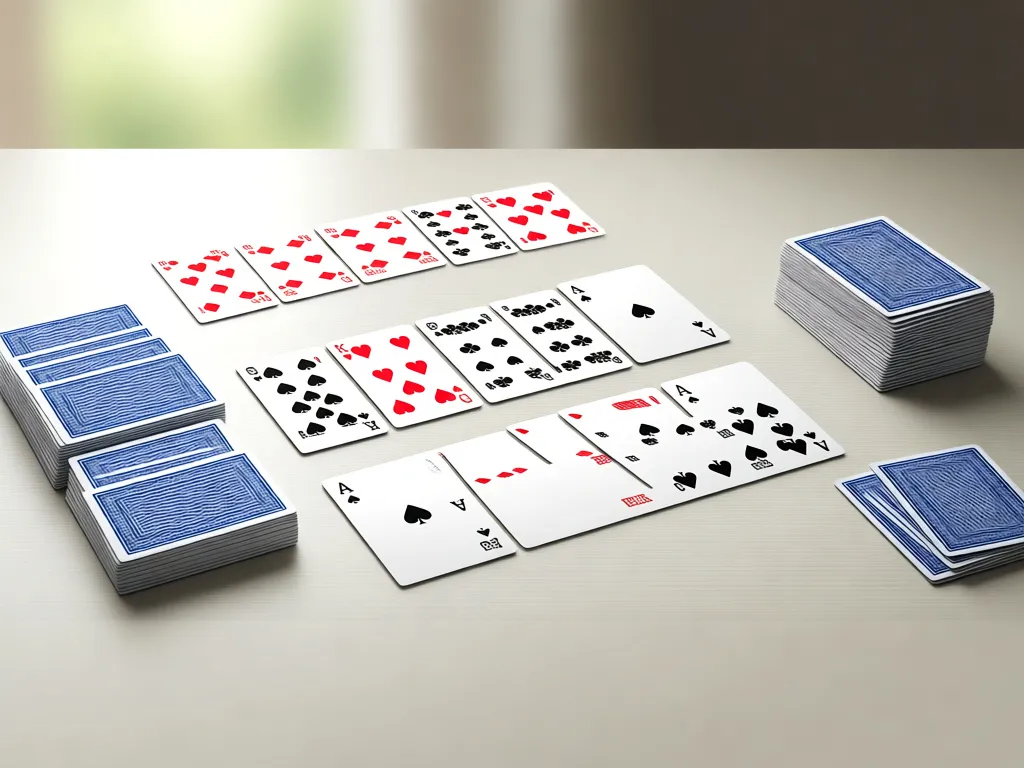
What is Klondike Solitaire?
Klondike Solitaire is the quintessential patience game that most players encounter first. The objective is simple in concept but rich in strategy: move all cards to the four foundations, one for each suit, in ascending order from Ace to King. The standard layout uses seven tableau columns, with cards dealt in a staggered pattern so that only the top card in each column is face up. The remaining 24 cards form the stock, with a waste pile representing cards drawn from the stock for play. Mastery comes from exposing hidden cards, planning moves ahead, and balancing the pace of play with the stock.
Read also: Klondike Solitaire on This Computer: Play, Rules & Tips
Setup and basic rules
A standard Klondike deal begins by laying out seven tableau columns. Column one contains one card, column two contains two, and so on up to column seven with seven cards. Only the top card in each column is face up; all others are face down. The remaining deck becomes the stock. The goal is to move cards to the foundations in ascending order by suit, starting with Ace, then 2 through 10, then Jack, Queen, and King.
Key rules to remember:
- Cards in the tableau must descend in alternating colors. For example, a red 7 can sit atop a black 8.
- Only the top face-up card of a tableau column (or the top card of the waste pile) can be moved to another column or to a foundation.
- Empty tableau spaces may be filled with a King and any sequence of cards beneath it, provided the top of the moved sequence fits the destination column.
- Foundations are built up in suit from Ace to King.
- Stock to waste draws are the engine of the game. In classic Klondike you typically draw three cards at a time from stock to waste and cycle through the stock as needed; some digital variants allow one-card draws. Pick a mode and stay consistent for comparable results.
Winning the game means eventually transferring every card to its matching foundation in the correct order. Not every deal is instantly solvable; some require careful sequencing and strategic patience. The key is to reveal hidden cards while preserving flexible moves for later stages of the deal.
Strategic play: from basics to advanced techniques
Good Klondike strategy blends a reliable start with flexible, forward-thinking play. Below are practical guidelines that translate to higher win rates across deals.
Foundations first vs tableau focus
Two common approaches shape your early decisions. Foundations-first thinking prioritizes moving any available Ace or early-number card to its foundation as soon as it is safe, freeing up tableau columns. Tableau-first thinking emphasizes exposing hidden cards and building longer sequences in the tableau to reveal new cards, even if that means delaying a move to a foundation for a moment. The best practice is to balance both: push cards to foundations when they unlock hidden content or reduce risk, but avoid blocking potential reveals in other columns.
Sequence discipline and blocking cards
Always assess how a move affects the future. A typical trap is moving a card that later obstructs access to a hidden card. When choosing between two valid moves, favor the option that reveals a new face-down card or frees a column to accept a King. When you see multiple face-down cards in a column, prioritize moves that gradually uncover them rather than completing a quick sequence elsewhere.
Two-pass plan for efficiency
A practical workflow is the two-pass plan. In the first pass, focus on revealing as many face-down cards as possible. In the second pass, optimize moves toward building foundations and consolidating tableau columns. This approach minimizes blind spots and increases opportunities to move more cards to foundations on subsequent passes. Adapt the plan to your draw mode: with three-card draws, you may need more strategic pauses to avoid locking yourself into awkward waste piles.
Practical tips for playing Klondike
These actionable tips translate theory into reliable plays:
- Always scan the entire deal before acting. A single unseen card can determine whether a move is safe or risky.
- Expose cards that unlock new moves. If a face-down card sits beneath a top card that can move, target the descent to reveal it.
- When a column becomes empty, evaluate the value of filling it with a King. A well-timed King often unlocks a buried sequence.
- With stock draws, plan a few moves ahead for both the stock and waste piles. Avoid waste-mounting situations where only a single card in waste can be moved.
- Consistency matters. If you prefer one-card draws, stick to it across the entire game. The cognitive load is lower and predictive planning improves.
In digital formats, keyboard shortcuts and drag-and-drop heuristics vary by platform. Use the tool’s guidance to learn the most efficient actions for your device, then practice to develop at-speed muscle memory. The core skill remains the same: maximize information, minimize wasted moves, and maintain flexibility for future turns.
History, variants, and why Klondike endures
Klondike Solitaire traces its lineage to early 20th-century card games and is named after the Klondike Gold Rush region in the Yukon. Its enduring appeal comes from a clean objective, clear rules, and a layout that rewards long-term planning. The version popularized by early computer platforms, especially Microsoft Windows in the 1990s, helped transform Klondike into the universal “go-to” solitaire variant. Today players enjoy both classic three-card draw and one-card draw modes, with digital assistants guiding moves and tracking statistics.
Beyond the basics, Klondike remains a fertile ground for practice across skill levels. Beginners gain familiarity with the flow of moves and the relationship between the tableau and foundations, while seasoned players refine efficiency, identify consistent reveal sequences, and study deal patterns that lead to stronger play. The category Klondike on this site consolidates rules, setup guides, winning strategies, and historical context to support steady improvement.
Common mistakes and how to avoid them
Avoiding common missteps keeps you aligned with efficient, deliberate play. Typical errors include:
- Overcommitting moves to foundations when doing so blocks key reveals in the tableau.
- Neglecting to empty a column with a King when it would unlock a hidden card from another column.
- Rushing through stock draws without planning ahead, which reduces your ability to react to changing tableau states.
- Ignoring the potential of uncovering multiple face-down cards in a single column by sequencing; always consider the next turn after a move, not just the immediate gain.
- Switching draw modes mid-game. Pick one draw rule and stay consistent to avoid confusing the deck’s behavior.
By recognizing these tendencies, you can build a more deliberate style. Pair disciplined decision-making with practice to see tangible improvements in win rates and speed.
Frequently asked questions
- Is Klondike Solitaire solvable on every deal?
- No. Some deals are unwinnable regardless of strategy. Practice helps you identify solvable patterns and optimize moves, but a subset of deals inherently cannot be completed to foundations.
- What is the best strategy to win at Klondike?
- Balance exposing hidden cards with careful foundation moves. Prioritize moves that reveal new face-down cards, avoid blocking columns, and choose a consistent draw mode. Fine-tuning comes with experience and deal analysis.
- Should I use one-card or three-card draws?
- Pick one mode and stick with it. One-card draws simplify decision-making and memory, while three-card draws can increase the challenge and require more strategic foresight. Both are valid; consistency matters more than the mode itself.
- How can I increase my win rate?
- Learn to recognize safe sequences, plan reveals, and maintain flexible columns. Practice with a focused routine, review failed deals to identify where you blocked progress, and adopt a two-pass approach to uncover hidden cards before committing to foundations.
- Are there quick exercises to improve Klondike skills?
- Yes. Start with gentle deals that emphasize uncovering hidden cards, then advance to tougher layouts. After each game, note which moves unlocked essential cards and which decisions blocked progress, then adjust your plan for future deals.