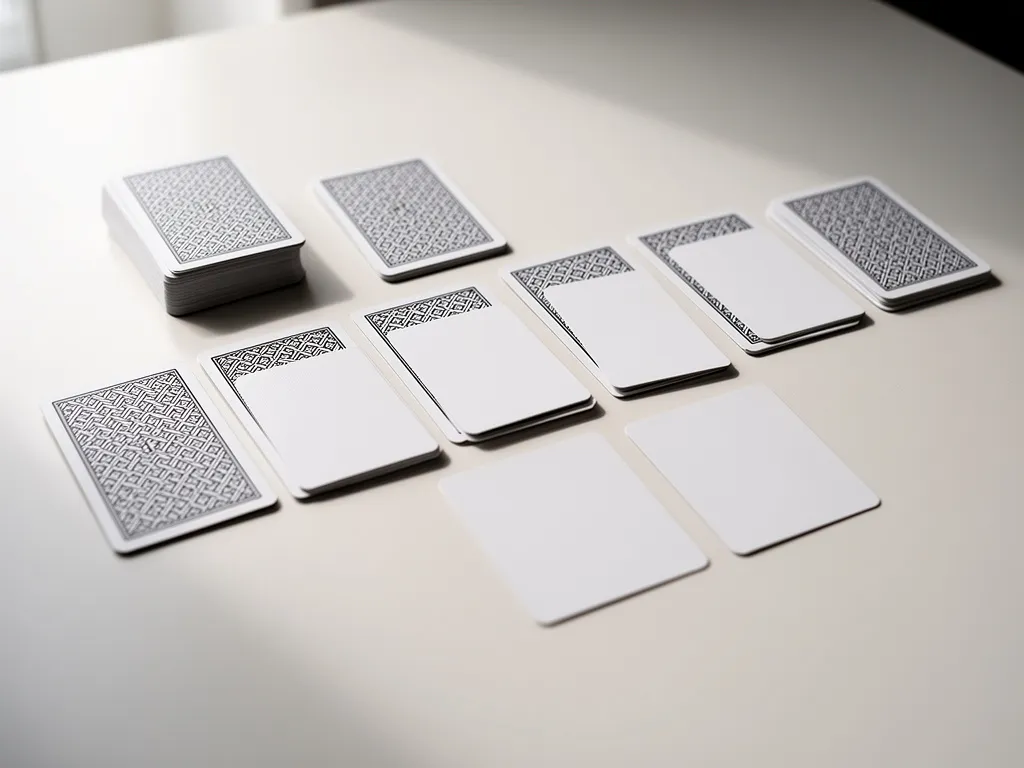
Klondike Solitaire (often called “Classic Solitaire”) follows a precise initial layout. Getting the setup right is the first step toward a fair game and consistent strategy testing. This guide walks you through every element of the deal, explains why each rule exists, and highlights the few variations that can change the starting position.
Read also: How to Play Klondike Solitaire: Rules, Setup & Winning Strategies
1. Understanding the Klondike Layout
Klondke uses a standard 52‑card French deck. The game consists of four zones:
- Tableau – Seven columns where the main play occurs.
- Foundations – Four piles, one per suit, built from Ace to King.
- Stock – The remaining cards that are turned over during play.
- Waste – Cards drawn from the stock that are not yet playable.
Each zone has a fixed position on most digital implementations, but the physical layout follows the same logical order.
2. Step‑by‑Step Setup Instructions
- Shuffle the deck thoroughly. Use a riffle or overhand shuffle until the order feels random. For digital play, the built‑in randomizer performs this step.
- Deal the tableau. Starting with the leftmost column, place one card face‑up on the first pile, then one face‑down on the second, two face‑up on the second, and so on until the seventh pile contains seven cards with the top card face‑up. The pattern is:
- Pile 1 – 1 card (up)
- Pile 2 – 1 down, 1 up
- Pile 3 – 2 down, 1 up
- …
- Pile 7 – 6 down, 1 up
- Place the remaining cards in the stock. After the tableau is complete, the undealt cards become the stock. Keep them face‑down in a single stack.
- Initialize the waste. Turn the top card of the stock over to start the waste pile. Some rules allow a three‑card draw; note this setting before you begin.
- Set up the foundations. Leave four empty spaces at the top right (or designated area) for the foundations. No cards are placed there until an Ace appears.
When playing on Solitaire Compass, the website automatically follows this exact sequence, but understanding it helps when you play offline or with custom rules.
Optional Settings That Influence Setup
- Draw count: 1‑card draw (classic) vs 3‑card draw (modern). This changes how quickly the stock is exhausted.
- Redeal limit: Some versions allow unlimited redeals; others cap at three. Adjust before starting.
- Timed mode: No impact on layout, but affects strategy.
3. Common Pitfalls & How to Avoid Them
Even seasoned players slip up during the initial deal. Here are the most frequent errors:
- Mis‑counting face‑up cards. Always verify that each tableau column ends with exactly one face‑up card. A quick visual scan prevents a hidden extra card.
- Leaving cards in the stock before the tableau is complete. Deal the entire tableau first; otherwise the stock will be short.
- Incorrect draw count. Confirm the draw setting (1‑card vs 3‑card) before you begin; switching mid‑game invalidates the setup.
- Placing foundation cards prematurely. Only Aces may start a foundation; placing any other card breaks the rules.
4. Variations That Affect the Initial Deal
While the classic Klondike layout is standard, several popular variants modify the setup:
- Vegas Klondike – Uses a 3‑card draw and a limited number of redeals, simulating casino conditions.
- Easy Klondike – Allows a 1‑card draw with unlimited redeals, making the game more forgiving.
- Double‑Deck Klondike – Uses two decks; the tableau still has seven columns but with 104 cards total. Setup steps are identical, just with twice the cards.
When you select a variant on Solitaire Compass, the site automatically adjusts the stock and draw settings while preserving the core tableau structure described above.
FAQ
- Q: Can I start a game with the stock already turned over?
- A: No. The stock must remain face‑down until the first draw. Turning it over changes the probability of early moves.
- Q: What if I accidentally place a face‑up card in the wrong tableau column?
- A: Pause the game, reshuffle the deck, and redeal. The integrity of the initial layout is essential for a fair game.
- Q: Does the “draw three” rule affect the tableau layout?
- A: The draw rule only changes how cards move from stock to waste; the tableau arrangement stays the same.
- Q: Are there any legal ways to rearrange the tableau before the first move?
- A: No. The tableau is fixed after the deal. Any rearrangement would constitute a different game.
By mastering these setup instructions, you eliminate the most common source of confusion and can focus on strategy, timing, and winning tactics. Whether you play on a browser, mobile app, or a physical deck, the steps remain identical – and the results are consistently fair.