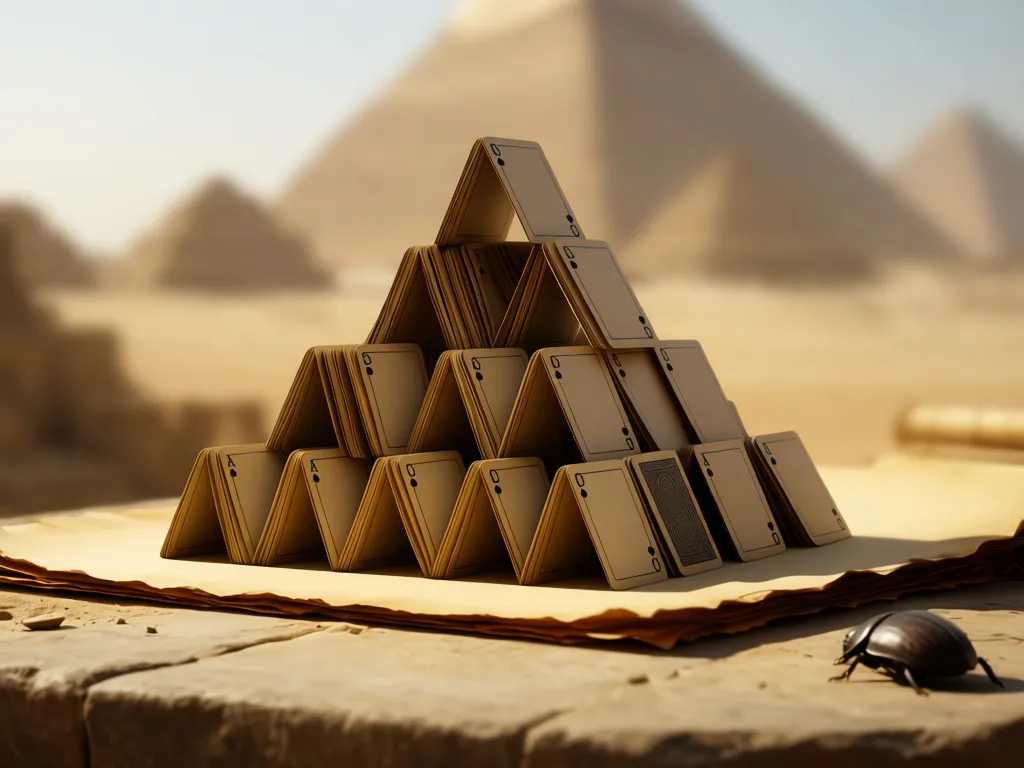
Welcome to a focused guide that blends the classic Pyramid Solitaire formula with an evocative Ancient Egyptian theme. This page on Solitaire Compass is designed for players who want a deeper understanding of the official setup, practical strategies, and the unique twists that come with a pyramidal layout steeped in history. Whether you arrived chasing a higher win rate or you’re curious about how the motif changes the playing experience, you’ll find actionable advice here that translates to real results.
Read also: Pyramid Solitaire Free Without Download: Play, Learn, Win
What is Ancient Egyptian Solitaire Pyramid?
The Ancient Egyptian Solitaire Pyramid is Pyramid Solitaire played with a visually rich Egyptian motif and optional thematic flourishes. The core mechanics stay faithful to the traditional game: remove pairs that total 13, reveal new cards from the stock, and clear the pyramid by exposing and pairing cards. The theme — including hieroglyphic fonts, scarab icons, and warm desert tones — enhances immersion but does not alter the fundamental rules. This variant is popular on desktop and mobile platforms because the layout remains the same while the visuals evoke the temples and tombs of ancient Egypt.
Rules, Setup, and Official Setup
Understanding the setup is essential to mastering any Pyramid Solitaire variant. The official setup for a standard Pyramid Solitaire game is consistent, whether you’re playing a pure version or a themed version like Ancient Egyptian. Here’s the canonical layout and flow you should expect and aim to replicate:
- Deal 28 cards face-up in a pyramid consisting of 7 rows (1 card at the top, 2 in the next row, down to 7 at the base).
- Place the remaining cards face-down in a stock pile to draw from. In many rulesets, the stock is the 24 cards not used in the pyramid, though some variants adjust the draw count.
- Only cards that are not covered by other cards in the pyramid are eligible for pairing. A card is considered exposed if there is no card directly on top of it in the row above or on the sides that blocks it.
- Pairs that sum to 13 can be removed. King (13) can be removed by itself. Aces (1) pair with Queens (12), Twos (2) pair with Jacks (11), Threes (3) pair with Tens (10), Fours (4) pair with Nines (9), and Fives (5) pair with Eights (8).
- From the stock, turn over either one card at a time or three cards at a time depending on the variant you’re playing. The draw method can affect difficulty and pace.
- The goal is to clear the pyramid or maximize the number of exposed pairs before the stock runs out.
In the Ancient Egyptian variant, the setup remains faithful to these rules, while the user interface emphasizes thematic continuity—scarab motifs, Egyptian columns, and hieroglyphic backdrops—to create an immersive but uncompromised gameplay experience. The category page you’re on emphasizes the official setup, pairing mechanics, and how to unlock trapped cards so you can consistently improve performance.
Core Mechanics and Why They Matter
To win at Pyramid Solitaire, you must balance immediate pairing opportunities with long-term prospects. The most important mechanics are:
- Card exposure: Prioritize moves that free up cards that sit in the pyramid’s interior, not just on the edges.
- Stock management: Decide when to draw from stock. Drawing too early can exhaust options; waiting can reveal critical pairs later.
- Combo planning: Look for sequences of potential pairs that leave several exposed cards under the same top card to maximize future options.
- Endgame awareness: As the pyramid shrinks, every exposed card matters. Avoid leaving unpaired cards that lock important pathways.
In the Egyptian variant, the visuals are designed to support cognitive load management. Clear icons and high-contrast hieroglyphs help you track pairs quickly, reducing misreads under time pressure. This presentation is part of the utility of Solitaire Compass: you gain a more efficient interface while applying proven strategies.
Strategies to Master the Pyramid
Below are field-tested strategies you can adopt immediately. The aim is to raise win rates and reduce dead-end situations.
- Always scan for two-way pairs first. If a card can pair with two options, choose the pair that frees up more high-value cards sooner.
- Expose the top of the pyramid. Prioritize moves that uncover cards in the upper rows; freeing top cards yields the most impactful returns.
- Plan two moves ahead. Before taking a pair, visualize the resulting exposed cards. If you can create a new pairing opportunity, take it.
- Use the stock strategically. In 1-card draw variants, you’ll rely on each revealed card; in 3-card draw, you must anticipate cycles and avoid wasting opportunities.
- Backtrack when stuck. If you reach a stalemate, consider alternative frees you could have pursued earlier; many wins come from a single alternative path.
- Learn the pyramid’s apex dynamics. Clearing the apex card often unlocks several new matches; prioritize moves that open this area when possible.
For players pursuing a higher win rate, we recommend alternating between deliberate, slower play sessions and timed drills that push you to clear the pyramid under pressure. The Ancient Egyptian theme can be tuned to suit your pace—slightly slower, more focused play can improve accuracy, while rapid play trains pattern recognition and speed.
The Egyptian Theme: Visuals, Variants, and Variations
The theme goes beyond cosmetics. It informs user experience with color palettes that map to sun-baked desert tones, aged papyrus textures, and hieroglyphic glyphs that demarcate moves. While the rules stay the same, the thematic cues help players memorize common patterns and reduce cognitive load during long sessions. Variants you’ll encounter include:
The draw pace changes the strategic calculus. 3-card draw offers more cycling opportunities but can accelerate run-out risk. - Timed challenges: Some themed editions incorporate optional time limits to heighten tension and test quick reasoning under pressure.
- Difficulty modes: Easy mode may reveal hints or auto-suggest moves, while hard mode demands full autonomy from the player.
At Solitaire Compass, you’ll find guidance that respects the official setup while explaining how the Egyptian motif can influence your approach. The goal is to deliver utility: actionable tactics, clear reasoning, and a path to consistent improvement.
Common Pitfalls and How to Avoid Them
Even experienced players stumble in Pyramid Solitaire. Here are frequent mistakes and practical fixes:
- Ignoring exposed cards. Always check every exposed card for potential pairs before drawing from stock.
- Overlooking single-card kings. Don’t forget to remove Kings when possible; they can be pivotal because they remove a blocking card and leave room for new matches.
- Bringing in new stock too soon. If you can make a pair from the pyramid, delay stock draws to preserve future options.
- Forgetting the long-term path. A narrow focus on immediate matches can trap you later; regularly review the overall layout and plan several moves ahead.
- Underutilizing the apex area. Clearing apex cards early often unlocks multiple matches; prioritize moves that impact the apex when feasible.
These pitfalls are especially relevant for the Ancient Egyptian variant, where the visual environment can tempt rapid, reflex-based play. A slower, more thoughtful rhythm often yields better results while still leveraging the motif for motivation.
Comparing classic Pyramid Solitaire to the Ancient Egyptian Pyramid variant helps you choose the right approach for your goals:
Themed visuals can improve recognition and reduce mistakes, aiding long sessions. If you want speed, fine-tune your focus on exposure patterns. 1-card draws emphasize careful selection; 3-card draws increase deck cycling but require broader pattern recognition. Use thematic skins to experiment with different pacing and notice how your decision-making changes with the visuals. High-contrast hieroglyphs and legible card designs reduce eye strain and support longer sessions without fatigue.
Side-by-side, the content from Solitaire Compass emphasizes official setup knowledge, actionable strategies, and presentation that enhances readability. The end result is a robust resource for players who want to blend a classic card game with an evocative ancient theme.
Frequently Asked Questions
Q: What exactly is Ancient Egyptian Solitaire Pyramid?
A themed version of Pyramid Solitaire that uses an Ancient Egyptian visual design while keeping standard mechanics like removing pairs that sum to 13 and using a stock to reveal more cards.
Q: What is the official setup for Pyramid Solitaire?
The pyramid consists of 28 face-up cards in seven rows, with the remaining cards forming a stock. Only exposed cards can be paired, and pairs must total 13, except Kings, which stand alone.
Q: How can I improve my win rate?
Focus on exposing top cards, plan two moves ahead, manage the stock carefully, and practice the apex-clearing strategy. Themed variants can help by offering better visual cues for memory and pattern recognition.
Q: Should I use 1-card or 3-card draw?
1-card draw emphasizes precision and planning, while 3-card draw increases cycling speed and can create more opportunities—but it also raises the risk of dead ends. Choose based on your comfort and goals.
Q: Where can I try Ancient Egyptian Pyramid online?
Look for themed Pyramid Solitaire variants on Solitaire Compass partner sites and on the Solitaire Compass hub page. The design ethos here prioritizes the official setup and practical strategies, with visuals that enhance focus and enjoyment.