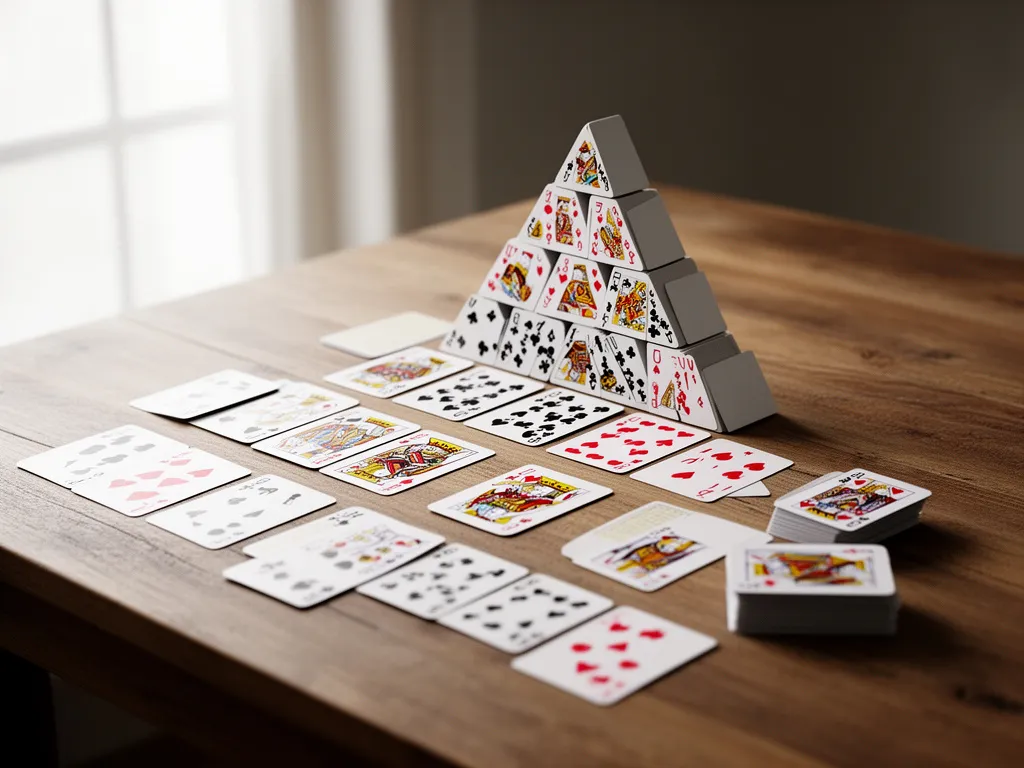
Solitaire Compass presents a comprehensive hub for Pyramid Solitaire. This triangular classic blends quick calculation with careful planning. Master the official setup, learn the sum-to-13 rule, and pick up expert strategies to improve win rate across standard and variant rules.
Read also: How to Pyramid Solitaire Play: Rules, Setup, and Expert Tips
How Pyramid Solitaire Works
The pyramid consists of 28 cards arranged in rows that decrease from 7 at the base to 1 on top, forming a triangle. The remaining 24 cards form the stock. The goal is to remove every card from the pyramid by pairing exposed cards that add up to 13. A King counts as 13 on its own and can be removed when exposed. You may use the top card of the waste pile (drawn from stock) with an exposed pyramid card to form a 13 pair. A card is exposed when it is not covered by two cards in the pyramid; only exposed cards can be used in moves. The game is won when the pyramid is cleared; it is lost if no moves remain and the stock is exhausted or you reach a dead-end.
Key terms in Pyramid Solitaire
- Exposed card: a card not covered on both sides by other pyramid cards
- Waste: the current face-up card from the stock you can use with pyramid cards
- Stock: the face-down deck you draw from, often limited to a single pass
- King: a 13 card that can be removed by itself when exposed
Official Setup and Turn Process
In the standard version, deal 28 cards into the pyramid, with the first row containing one card and each subsequent row adding one card until the bottom row has seven cards. The remaining 24 cards go face-down into the stock. Start by turning the top stock card face-up to the waste. You may use the waste card or any exposed pyramid card to form a pair that sums to 13. Remove both cards when a valid pair is found. When a pair is removed, new cards in the pyramid become exposed, creating fresh options. If the stock contains cards and you run out of valid moves, you can draw the next stock card onto the waste and continue. Many digital versions offer a single pass through stock, while others allow multiple passes or reshuffles. Understanding the exact rule variant matters for strategy and scoring.
Track which cards are still in play. If a key card is buried beneath several layers and cannot be uncovered without disturbing other moves, you may need to forego a less critical pair to keep that card accessible. This is where long-term planning separates beginners from consistent winners.
Core Strategies to Improve Your Win Rate
Winning Pyramid Solitaire is as much about careful sequencing as it is about luck. Apply these practical strategies to increase your chances across sessions:
- Target exposures: prioritize moves that uncover two new cards from the pyramid rather than releasing a single card.
- Maximize 13 pairs: always consider both the current waste card and any exposed pyramid cards for 13-sum pairs.
- Avoid blocking columns: if a move will leave a high card hidden beneath a heavier stack, weigh the long-term benefit before acting.
- Manage stock life: in single-pass variants, plan how many moves you can make before stock is exhausted. In multiple-pass variants, balance exploring new pairs with preserving key exposed cards for later.
- Use a mental map: remember which rows and columns still have hidden cards and which corners tend to generate the most dead ends.
Practical play example
Imagine an exposed 5 in the left edge of the pyramid and a visible 8 near the top. The 5 can pair with the 8 to total 13, uncovering the card beneath the 5 and enabling new options. If the 8 also unlocks a new face-up card from the pyramid, removing this pair can cascade into multiple fresh moves. In practice, you will often need to re-evaluate your plan after each removal, especially in the bottom rows where multiple cards become exposed at once.
Pyramid Solitaire Variants and History
Original Pyramid Solitaire is a one-pyramid layout with a single stock. Online and mobile platforms offer variants that tweak stock rules, timing and layout. Common variants include multi-pyramid screens, timed challenges, and relaxed modes that allow more frequent passes through stock or reshuffles. These variants change the pace and difficulty, so when you practice on Solitaire Compass you can switch modes to fit your skill level and preferred tempo. While the core rule remains sum-to-13, the way you access and manage exposed cards varies by version, so adapt your approach accordingly.
Common Pitfalls and Practical Tips
Avoid these frequent mistakes that undermine performance:
- Rushing to clear the pyramid without examining all exposed options
- Ignoring the exposed waste card and over-relying on stock for moves
- Overlooking a potential two-card exposure that unlocks more cards
- Failing to track which cards remain in the pyramid and stock
FAQ
- Can I win Pyramid Solitaire consistently?
- Consistent wins come from steady pattern recognition, careful sequencing, and discipline. Luck matters, but deliberate play increases win rates over time.
- How many cards are in the pyramid and stock?
- The pyramid holds 28 cards; the stock contains 24 cards in the standard version.
- Is variant approach better for learning?
- Yes. Starting with a single-pass stock variant simplifies decisions, then you can practice multi-pass or timed modes to boost speed and planning.
- Is Pyramid Solitaire available on mobile?
- Yes. Many apps and websites offer offline and online versions with optional variants for practice and challenge.