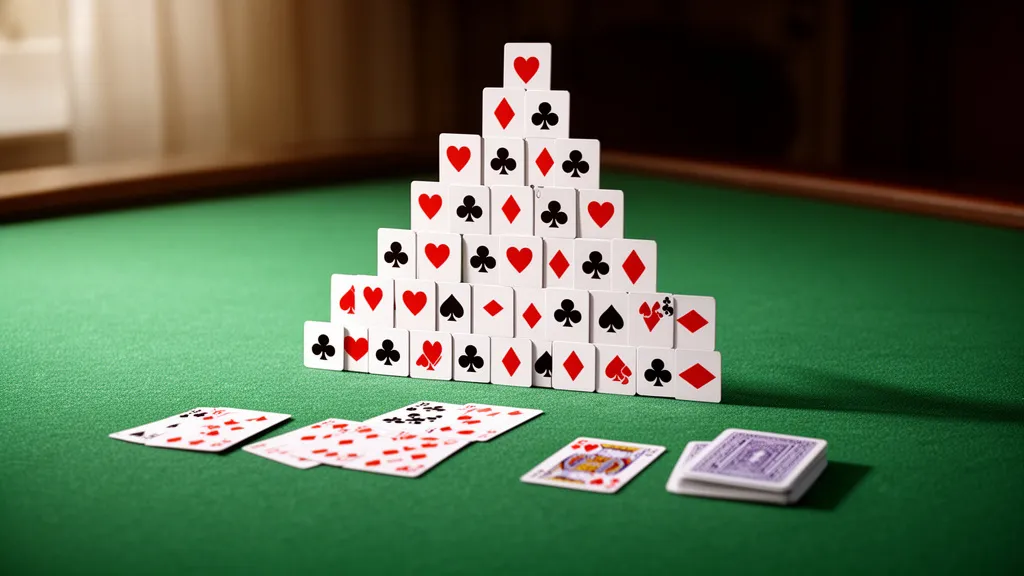
Welcome to the Pyramid Solitaire hub on Solitaire Compass. This guide focuses on the free pyramid solitaire old version, covering canonical rules, official setup patterns, and practical strategies you can apply today to improve your win rate. While modern variants exist, the classic build remains highly popular for its clean layout and math-based challenge.
Read also: Pyramid Solitaire Card Game: Rules, Strategy, and Variants
Understanding Pyramid Solitaire Old Version: Rules and Setup
The basic objective is simple: remove cards by forming pairs that total 13. A King counts as 13 on its own. The pyramid is built in 7 rows, totaling 28 cards, with each row overlapping the row beneath. Only cards that are not covered by any other card are eligible for play. A stock and discard (if the variant includes one) give you additional chances to pair up remaining cards.
- Goal: clear the pyramid by removing cards in valid 2-card pairs that sum to 13, or remove Kings directly.
- Pyramid structure: 7 rows, 28 visible cards, with each card (except the top) partially obscured by two cards below.
- Stock and redraw: some builds provide a draw pile. You may draw from the stock to find matching partners for exposed cards; rules vary by version.
- Scoring and progress: not all old builds show a running score; focus on clearing the pyramid efficiently rather than chasing a high score.
How to Pair Cards to 13
Always look for unavoidable cuts that unlock multiple potential matches. Start with Kings when they are free, since they remove themselves without pairing. Then seek pairs such as 10 and 3, 9 and 4, 8 and 5, 7 and 6, or 2 and 11 (Jack) when available. A disciplined approach frees future moves and reduces dead ends.
Old Version vs Modern Versions: What to Expect
Classic builds emphasize a straightforward layout and minimal interface. Modern variants often add hints, auto-undo, sound effects, and optional cosmetic tweaks. If you prefer a nostalgic feel with slower pacing and fewer distractions, the old version is usually the better fit.
Device compatibility matters. Some old builds are optimized for low memory usage and work well on older Windows, macOS, or mobile hardware, while newer browsers and operating systems may attempt to run nonstandard code or display features not present in the classic release. Always verify the version's compatibility notes before installing.
Strategies to Improve Your Win Rate
- Plan two moves ahead: identify which exposed cards unlock the most future matches.
- Prioritize cards that free up blocked partners rather than making random matches.
- Manage the stock wisely: if the game allows redraws, use them only when the exposed cards form promising pairs.
- Kings first: removing a free king reduces the number of blocked cards.
- Balance risk and reward: if a clean path to clear the pyramid looks unlikely, consider a strategic retreat rather than forcing a bad sequence.
Accessing a Free Pyramid Solitaire Old Version Safely
To preserve your device and data, download only from reputable sources. Check file integrity with checksums where available, read user reviews, and avoid installers bundled with extra software. If you are unsure about a source, look for official mirrors or pages that explicitly offer classic builds and clear licensing notes. For mobile play, prefer versions that explicitly state compatibility with your device and OS version.
FAQ
Is there an official old version of Pyramid Solitaire?
There is no single official archive. Use reputable sources, verify file integrity, and avoid untrusted download hosts.
Can I play Pyramid Solitaire old version on mobile?
Some builds are mobile-friendly, but many classic versions may lack current OS compatibility. Look for mobile-optimized options or modern equivalents that preserve the classic rules.
What distinguishes old version from modern Pyramid Solitaire?
Old builds emphasize the traditional pyramid layout and simple pairing rules, while newer versions add hints, improved visuals, and optional modifiers or modes.