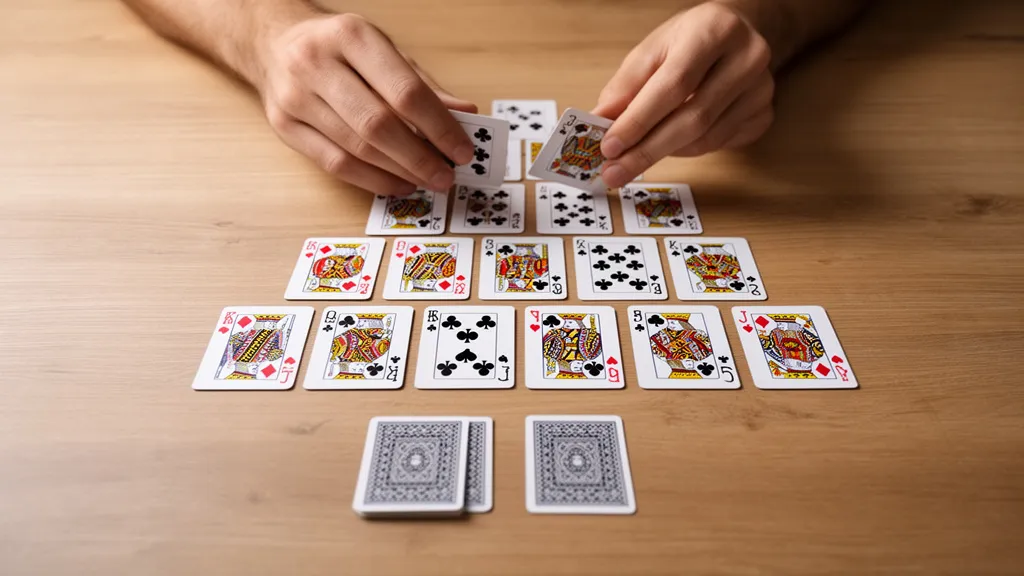
Pyramid Solitaire hinges on two simple facts: card values and a reliable layout. In the classic version you clear the pyramid by forming pairs that sum to 13, and you may remove a king alone. The 28 pyramid cards are dealt in seven rows, with 24 cards in the stock for draws. Understanding the values and the official setup is the foundation of strong play.
Read also: Pyramid Solitaire Winning Strategy: Master the Peak
Card values and official setup
Card values in Pyramid Solitaire are straightforward:
- Ace through nine: face value equals its pip count (A = 1, 2 = 2, ..., 9 = 9).
- Ten has value 10; Jack 11; Queen 12; King 13.
- Removed pairs must sum to 13. A lone king can be removed by itself (13).
Official setup details:
- Layout: seven rows in a pyramid, starting with one card on the top and increasing to seven on the bottom, with overlapping cards that create a triangular shape.
- Deck: 52 cards total, with 28 in the pyramid and 24 in the stock.
- Stock: you draw one card at a time and can use the drawn card to pair with any exposed pyramid card that makes 13, depending on the variant you are playing.
Strategies for clearing the pyramid
Developing a consistent strategy reduces random luck and improves your win rate. Key principles:
- Always remove kings when they appear, since they free the card beneath and do not require a partner.
- Prioritize moves that uncover new exposed cards. A move that frees two or three new cards is usually preferable to a move that exposes only one new card.
- Be mindful of blocks. If a card near the top is blocking several important cards, plan to unlock it as soon as possible.
- Assess stock interactions. When you draw, consider how the new card pairs with currently exposed pyramid cards and what it reveals in the next steps.
- Keep options open. If you have two valid matches, prefer the one that frees higher value cards or cards with few visible partners.
Practical decision criteria
- Can the move free two or more cards for future draws
- Does removing this pair expose any card that would unlock another pair
- Is a king available now that will relieve a tight corner
- Will drawing a card open a critical path
Endgame and common pitfalls
In the late game the pyramid becomes a tight puzzle. If you reach a dead end, consider alternate pairings from earlier moves if the variant allows backtracking. Common pitfalls include over drawing, missing obvious two card sums because a card is blocked, and focusing on small removals while ignoring cards that unlock more valuable candidates.
Variant considerations and deck management
Variants exist, but the core skill remains. Some versions allow more than one draw per stock, others require you to go through the stock once. For most online versions you can cycle through the stock while trying to clear all 28 pyramid cards. Practice with the standard seven row pyramid to build a reliable mental model for enabling future moves.
Step by step play guide for consistent practice
- Survey the pyramid and identify all single key moves, especially kings and top row matches
- Record a quick mental map of which exposed cards unlock the most new cards
- Make the safest moves that unlock new exposure, prioritizing freeing higher rows
- Draw from stock as needed, evaluating if the new card creates a better match than any existing option
- Repeat the process until either the pyramid is cleared or no moves remain
How this guide helps improve win rate
Practice with consistent logic rather than relying on luck. The more you map which cards unlock others, the faster you will identify safe pairs and reduce dead ends. Use the stock to bridge gaps, but do not waste draws on marginal matches. A disciplined approach translates into higher win rates across both casual and competitive play on Solitaire Compass.
Frequently Asked Questions
- How many cards are in the Pyramid in the standard setup?
- There are 28 pyramid cards arranged in seven rows.
- Can I use a face-down card in a move?
- No. Only exposed cards may be used for pairing or removal; a face-down card must be uncovered first.
- What is the basic objective of Pyramid Solitaire?
- Remove all pyramid cards by forming pairs that sum to 13, and remove kings on their own when possible.
- How does the stock work in the classic version?
- You draw one card from the stock at a time and can use it to pair with exposed pyramid cards that make 13, depending on the variant.
- What are common mistakes and how can I avoid them?
- Avoid excessive drawing, missable uncovered cards, and failing to plan ahead for unlocks that affect multiple cards.