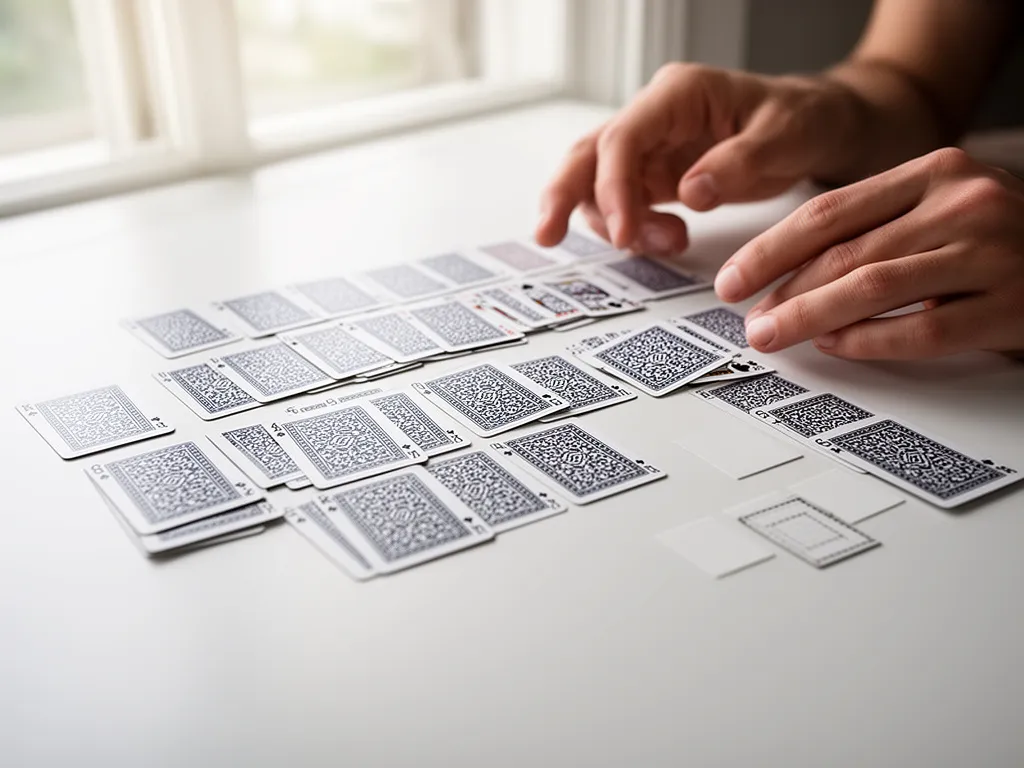
Welcome to the FreeCell category hub on Solitaire Compass (solitaire-free.org). This page presents a deep, practical look at FreeCell—a true test of skill with an open-card layout and four free cells. In this guide you’ll find actionable rules, proven strategies, and diagnostic tips designed to lift your win rate across standard Windows-style deals. Whether you are a curious beginner or an experienced solver aiming for consistency, this hub is built to help you think several moves ahead and stay organized under pressure.
Read also: Master Free Freecell Solitaire: Strategies, Deals & Tips
What is FreeCell?
FreeCell is a solitaire variant where all cards are dealt face up in eight tableau columns. The four free cells act as temporary storage to rearrange cards so you can build foundations by suit from Ace to King. Unlike some other solitaires, almost every deal in FreeCell is solvable with the right approach, which makes discipline and planning essential components of success.
Open-card layout and free cells
All cards start exposed, which allows you to see future moves. You can use the four free cells to hold single cards temporarily as you uncover the next playable card. Movement rules emphasize single-card transfers between tableau columns or to the foundations; complex sequences are handled by sequencing through careful use of free cells rather than moving large stacks in one go.
Key Rules and Setup
Foundations: Build up from Ace to King, one suit at a time. Tableau: Cards can be moved onto a card that is one rank higher and of the opposite color. Free cells: You have four spots to temporarily store cards, enabling you to reveal hidden cards and unlock new plays.
Core play principles
- Move any card that can go to a foundation as soon as it is available.
- Use free cells to uncover hidden cards, not to hoard cards indefinitely.
- On tableau, aim to create descending, alternating-color sequences to enable future moves.
- Avoid overloading a column with a long, immovable tail that blocks key discoveries.
Strategic Principles for Consistent Wins
Mastering FreeCell requires planning, resource management, and pattern recognition. Below are core strategies used by strong players to maximize success across deals.
Strategic pillars
- Four-cell discipline: Treat free cells as temporary workspaces. Don’t fill them with cards you can move later without gaining progress.
- Foundation-first mindset: When a foundation card (A, 2, 3, ...) becomes available, prioritize moving it up when safe to prevent backtracking.
- Column management: Keep columns with flexible cards near the top and avoid locking a critical Ace or 2 in a column tail.
- Backups and parity: Plan two or three moves ahead, ensuring there are always at least two possible moves if one path stalls.
Common pitfalls and how to avoid them
- Overfilling free cells with cards that have limited future use. Solution: reserve free cells for uncovering key cards rather than for temporary parking.
- Ignoring potential multi-step advances that unlock new cards. Solution: routinely check each column’s top card for foundation potential.
- Forgetting about color alternation on the tableau. Solution: only place a card on a card that is one rank higher and of the opposite color unless you’re moving to foundation.
Practical Play: Open-Card Layout and Free Cells
Putting theory into practice means adopting a repeatable play routine. Here’s a concrete, repeatable approach you can apply to any deal.
- Scan all eight tableau columns and four free cells to identify any immediate moves to foundations.
- Make every safe move to a foundation before attempting more complex rearrangements.
- If no foundation moves exist, look for a card that can be moved to a different tableau column to reveal a new card.
- Use free cells to uncover hidden cards, then re-evaluate for foundation opportunities or new column transitions.
- When a King becomes accessible and a free cell is empty, consider starting a fresh sequence in that column to unlock space for new moves.
For practice, alternate between daily deals and curated problem sets that emphasize different aspects: freeing up kings, accelerating foundation progress, and maintaining column flexibility. The key is consistent, deliberate moves rather than reckless reshuffles.
Advanced Techniques and Diagnostics
As you grow more proficient, you’ll start recognizing solvability patterns and bottlenecks. Use these diagnostics to assess a deal quickly and decide on a strategy.
Solvability heuristics
- Always check whether a free cell will free a crucial card in the next few moves.
- If you find yourself blocked for more than a handful of moves, reassess the last few placements and consider rearranging to free up the path to the Ace or a King.
- Maintain at least two potential moves at any time to avoid dead ends.
Difficulty and practice curves
Most standard FreeCell deals are solvable with careful use of the four free cells. With deliberate practice, many players push win rates toward the high end of the spectrum, especially when focusing on foundational moves and disciplined free-cell usage.
Practice Paths and Tools
To improve steadily, mix guided practice with self-evaluation. Consider these paths:
- Play a set of deals focusing on quick foundation progress to develop rhythm.
- Use weak deals to practice revealing cards with minimal moves, emphasizing free-cell planning.
- Compare your approach to a solved path after a run to identify where you could have conserved moves or freed space earlier.
Digital variants on Solitaire Compass encourage a structured approach with open cards and four free cells, making it ideal for deliberate improvement and repeatable measurement of progress.
FAQ
- What is FreeCell?
- FreeCell is a solitaire where all cards are dealt face up in eight columns. Four free cells serve as temporary storage, and foundations build up by suit from Ace to King.
- Can you win every FreeCell deal?
- With disciplined play and proper free-cell management, most deals are solvable. Exceptional practice can yield very high win rates, though not every single deal is guaranteed in every variant.
- How many free cells are there?
- There are four free cells available to temporarily store cards during the solution process.
- Are there differences between digital FreeCell versions?
- Yes. Some apps may differ slightly in how moves are framed or how auto-moves behave. The core rules—foundations by suit, tableau building by alternating colors, and four free cells—remain consistent on Solitaire Compass.