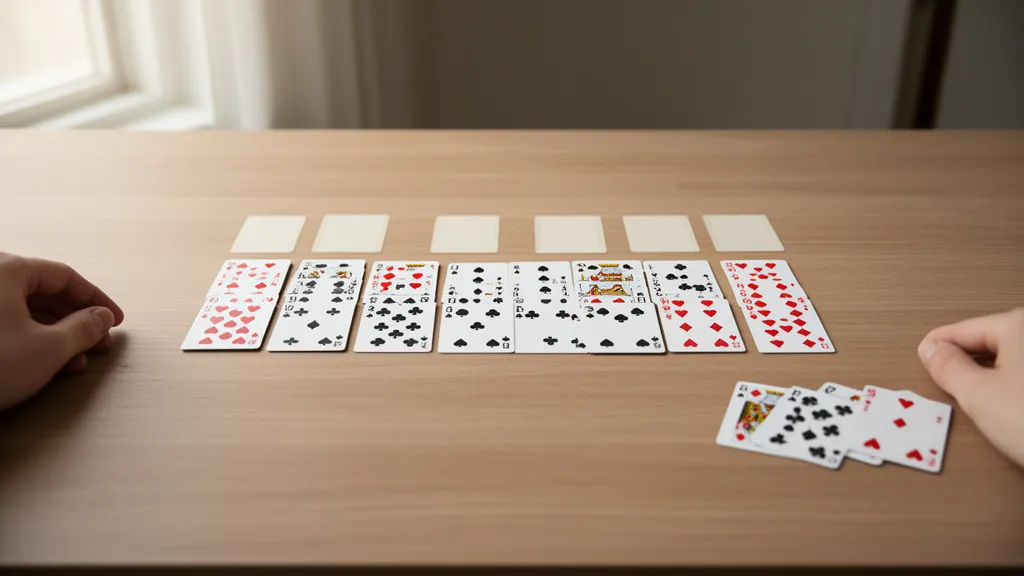
FreeCell is a true test of planning and patience. With eight tableau columns, four free cells, and four foundations you move cards one at a time to build up suits. The open-card layout means nearly every deal is solvable with the right approach and careful management of space. This guide on Solitaire Compass covers the essentials of FreeCell gameplay, practical strategies to boost your win rate, and specific techniques you can apply in your next session.
Read also: FreeCell Live: Master FreeCell on Solitaire-Free.org for Players
Understanding the FreeCell layout and rules
The board consists of eight cascading piles (tableau), four free cells you can park cards in temporarily, and four foundations where you build up by suit from Ace to King. You move a card or, in some software, a contiguous run of face-up cards, to a destination that maintains a legal order. On the tableau you must stack cards in descending order and in alternating colors. Foundations accept cards by suit in ascending order, starting with Ace.
The board components
Eight cascades hold the bulk of the play. The four free cells act as temporary storage, enabling you to rearrange the order of future moves. The four foundations track progress toward the completed deck, one suit at a time.
Movement rules and limitations
You can move a single card to a free cell or to another cascade if the move preserves descending order with alternating colors. You typically place the Ace in the foundation first, then the two, and so on. Depending on the software, moving a long run of cards may be allowed only if you have enough free cells and an empty space, but in classic rules you move one card at a time.
Core strategies to boost your win rate
Winning more FreeCell deals comes down to space management, forward planning, and disciplined execution. Below are core strategies you can apply in most games.
Plan around foundations and freeing Aces
- Always aim to expose and move Aces to foundations as early as possible.
- Prioritize cards that unlock new moves rather than merely clearing cards.
- Keep a rough plan for each column before using a free cell to park a card.
Free cell management and column discipline
- Use free cells to separate difficult sequences, not as a dump for unneeded cards.
- Avoid filling a free cell with a card that needs to stay in place to allow other moves; choose entries that open up pathways.
- When a column becomes nearly empty, look for opportunities to move a long run onto another column to free a space for rearrangement.
Endgame patterns and problem avoidance
- In the late phase, ensure every remaining column has a clear destination for the top card of a run.
- If you stall, try a different card from a different column to break the deadlock rather than forcing a single move repeatedly.
- Be patient with the finish; the last few moves often require precise sequencing that uses the foundations as anchors.
Dealing with tricky deals and practice routines
Some deals test your pattern recognition more than raw speed. A solid practice routine helps you see common layouts and the best reoccurring maneuvers.
Practice plan you can follow
- Play 5 to 10 deals focusing on freeing Aces and exposing two-card sequences.
- After each deal, review the path you took and identify the first pivot move that unlocked multiple options.
- Track how many free cells you used and how many moves were necessary to complete the foundations.
- Repeat with intent to reduce the number of moves and avoid blocking cards in the early stages.
Common mistakes and how to fix them
Even seasoned players fall into repeat errors that reduce efficiency and win rate.
- Blocking key cards behind nonessential moves. Fix by prioritizing moves that release hidden Aces and low cards.
- Overloading a free cell with a card that belongs in the tableau. Fix by keeping free cells for rapid rearrangement and using an empty column to temporarily host longer runs.
- Ignoring endgame sequencing. Fix by planning the final arrangement early and keeping a clear path to the foundations.
FAQ
- Is FreeCell solvable for almost all deals
- With standard rules and careful play, most deals are solvable. A small minority can be unsolvable depending on the initial layout and card distribution.
- Should I memorize sequences or focus on patterns
- Focus on recognizing repeatable patterns and plan-based moves. Memorizing exact sequences is less helpful than understanding how freeing specific Aces and columns creates options.
- Can I improve my win rate quickly
- Yes. Regular practice, deliberate reviews of difficult deals, and a methodical approach to free cells and column management typically yield steady gains.
- How does FreeCell differ from Klondike
- FreeCell uses four free cells and an open layout with a focus on column management and space control, whereas Klondike emphasizes tableau runs and fewer storage options.