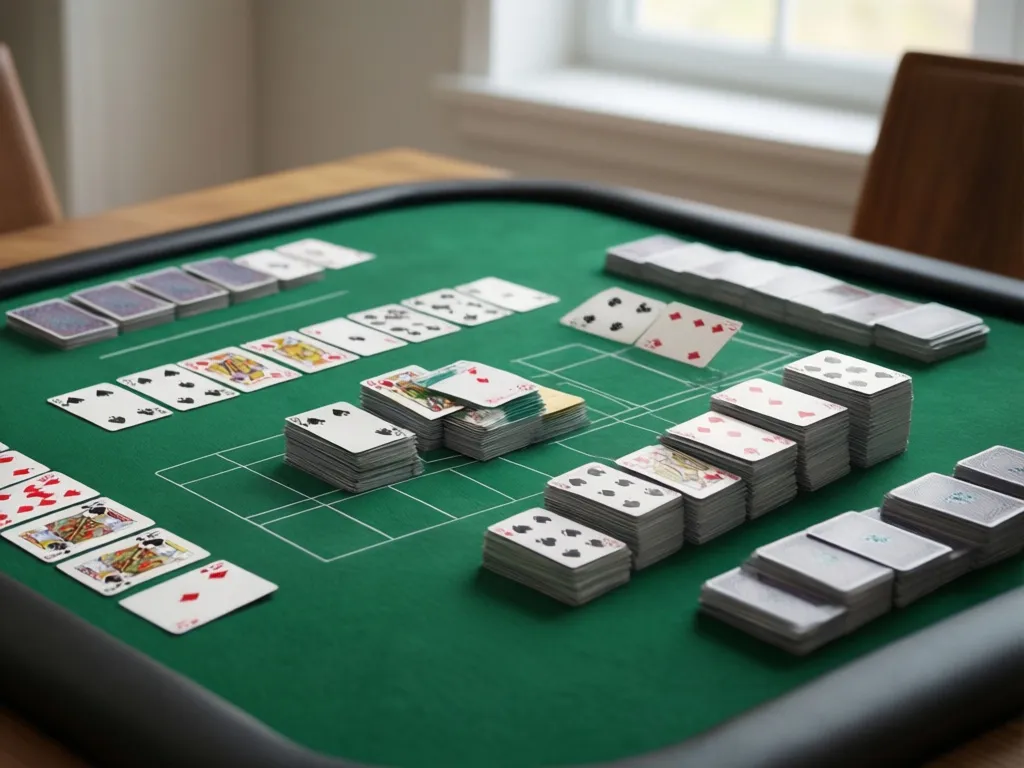
Welcome to the definitive FreeCell Solitaire online hub on Solitaire Compass. FreeCell challenges are among the most solvable yet demanding card puzzles on the web, thanks to four free cells and an open-card layout. This guide helps players of every level build skill, improve win rates, and understand the digital mechanics that differentiate online play from paper cards.
Read also: Classic FreeCell: Master the Open-Card Solitaire Strategy
Why FreeCell Online Remains a Top Digital Card Challenge
In FreeCell, almost every deal is solvable with the right decisions. The online format exposes you to dozens of deals daily, immediate feedback on moves, and the ability to undo mistakes. With practice you learn to recognize patterns, such as when a card in the tableau can unlock a chain of moves or when a free cell will become a critical resource.
- Immediate feedback and undo
- Consistent dealing from a modern engine
- Accessible from any device on Solitaire Compass
Core Rules and Setup: Open-Card Layout, Free Cells, and Foundations
FreeCell uses eight tableau columns, four free cells, and four foundations by suit. The goal is to build each foundation from Ace to King in its suit. You can move a card from a tableau column to another column if it will stay in descending order by rank and alternating colors, or place a card on a foundation if it matches the next rank. Free cells act as temporary storage, enabling rearrangements that unlock deeper sequences.
Core Techniques for Consistent Wins
Mastering FreeCell online requires a mix of planning, pattern recognition, and cautious resource management. The following techniques form a practical core:
- Plan several moves ahead: anticipate how freeing a higher card will enable multiple subsequent moves.
- Use free cells strategically: rarely fill all four at once; keep at least one free cell open for chaining cycles.
- Sequence management: when possible, expose the lowest card in a column to access hidden cards.
Sequencing Strategies
Identify sequences that can be moved intact when an empty column or free cell becomes available. Moving the top card first is often essential to unlock the undercards.
Managing Free Cells and Safe Moves
Keep free cells as temporary staging areas. Avoid placing suits in a way that blocks access to key cards. If you feel stuck, retreat by restoring a previously undone sequence rather than forcing a risky move.
How to Choose the Best FreeCell Online Experience
Not all online FreeCell implementations are equal. When evaluating a platform, consider:
- Move responsiveness and reliable undo/redo
- Accurate rule interpretation across devices
- Quality of daily deals and solvability distribution
- Helpful hints, Tooltip guidance, and learning aids
- Privacy, data safety, and fair play
Common Pitfalls and Practical Tips
Even experienced players stumble. Here are realistic traps and how to avoid them:
- Overloading a free cell with a non-essential card
- Forcing a sequence when the necessary lower card is trapped behind another suit
- Ignoring the potential of a discreet move that unlocks two or three cards later
FAQ
- Q: Is FreeCell Solitaire online solvable for most deals?
- A: Yes. With practice and proper use of free cells, you can solve a large majority of online deals. Some require careful sequencing and patience.
- Q: Can I undo moves in FreeCell online?
- A: Nearly all online FreeCell interfaces, including Solitaire Compass, support undo/redo so you can learn without penalty.
- Q: What’s the best way to start a new deal?
- A: Start by exposing a card in the top row, look for foundations that can be started, and avoid filling all free cells too early.