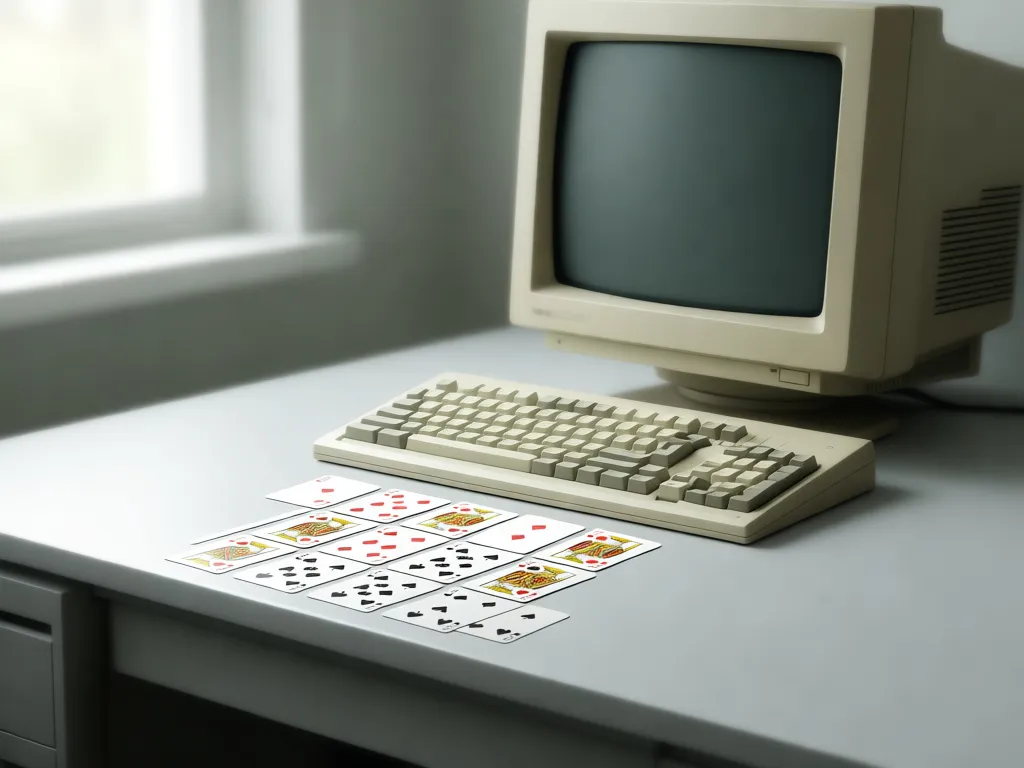
Welcome to the FreeCell hub on Solitaire Compass. This article traces the original game history of Microsoft FreeCell, showing how a classroom project evolved into a Windows staple and how the open-card layout informs current play.
Read also: Play FreeCell: Master the Classic Solitaire Challenge Today
Origins and Early Seeds
The FreeCell variant emerged in the late 1970s as a refinement of classic Klondike ideas. Widely attributed to Paul Alfille, the program began as a teaching project on early computer platforms. Alfille coded FreeCell for a personal computer environment, emphasizing an open tableau and the use of four free cells to accelerate solving. This early work traveled through hobbyist circles and multiple ports, laying the groundwork for a stable, solvable experience that appealed to both students and hobbyists.
Platforms and Spread
Initial versions circulated on university and homebrew systems. While exact dates vary by source, the core concepts—an open tableau, four free cells, and a stock/foundation process—remained intact as FreeCell moved from mainframes and early microcomputers into more accessible PCs, and eventually into mainstream gaming through Windows.
Microsoft and the Windows Era
Microsoft adopted FreeCell as part of its strategic push to provide engaging, solvable solitaires on Windows. The Windows implementation popularized FreeCell by delivering a high-quality, consistently solvable experience across millions of machines. A defining feature of the Windows FreeCell variant is the use of a large, fixed pool of predefined deals. These deals enable players to share solutions, compare performance, and study strategy with reliable reproducibility. While other FreeCell variants exist on mobile and web, the Windows format established the classic standard that many players still seek today.
Rules, Strategy and Why History Matters
The original FreeCell rules are straightforward but demand planning and careful management of moves. You control four free cells to temporarily store cards while building foundations from Ace to King in each suit and maintaining an open tableau. The four free cells differentiate FreeCell from many other solitaire games by increasing flexibility and, paradoxically, the challenge of keeping tracks of potential moves. Understanding this design helps modern players appreciate why certain sequences are solvable in early versions and how modern digital variants preserve that core balance.
Milestones and How to Use This History in Your Practice
- Paul Alfille develops the initial FreeCell concept for early computer systems in the late 1970s.
- Ports appear across platforms, spreading the game's popularity beyond native machines.
- Microsoft includes FreeCell on Windows, popularizing the title and enabling reproducible play with a fixed deal pool.
- Open-card mechanics remain central, guiding strategy: prioritize freeing moves in the tableau and using free cells for key relocations.
- Modern FreeCell variants maintain the original rules while offering new layouts and performance-tracking features.
Category: FreeCell on Solitaire Compass
In this category, you’ll find expert analyses, practical strategy guides, and historical context that connects FreeCell’s original design to today’s digital play. Use the history as a lens to improve your solutions, experiment with sequences, and learn to recognize patterns that recur across deals.
FAQ
Q: When was FreeCell originally created?
A: The core concept is attributed to Paul Alfille in the late 1970s, developed for early computer systems as a variant of Klondike with four free cells.
Q: Which Windows versions included FreeCell?
A: FreeCell was popularized through Windows in the 1990s and remained a staple through later Windows releases, becoming a household computer pastime.
Q: Are all FreeCell deals solvable?
A: FreeCell is designed so a large majority of deals are solvable, but not every deal has a solution. Strategy, careful move order, and free-cell management matter.
Q: How does understanding original rules help today?
A: Knowing the open-card layout, four free cells, and stock-to-foundation flow helps you plan sequences, manage bottlenecks, and recognize patterns common to both classic and modern variants.