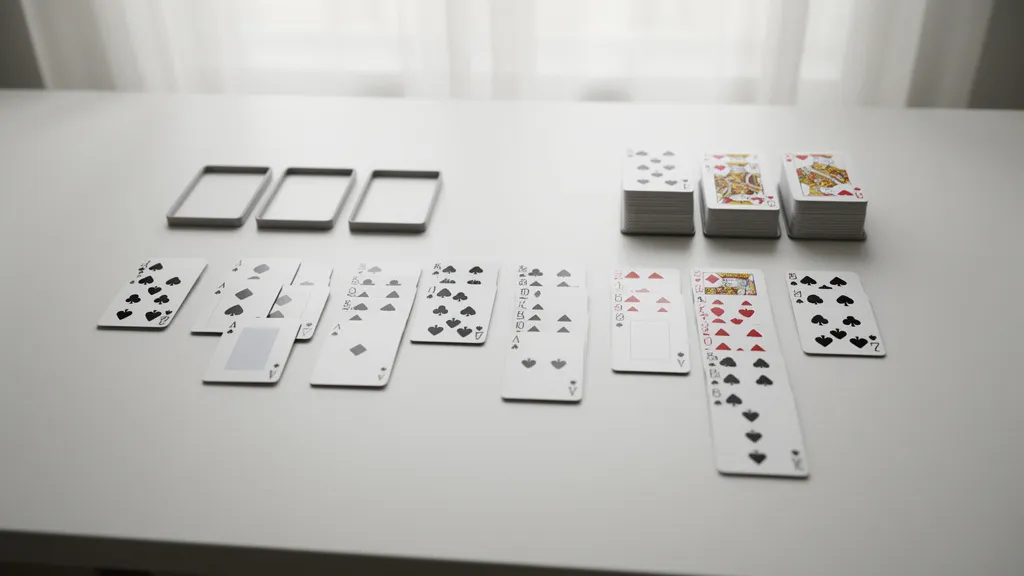
Welcome to your ultimate FreeCell Solitaire hub. On Solitaire Compass, freecell games are explored with a focus on the official setup, four free cells, and the opening card play that shapes every puzzle. The goal remains the same: move all cards to the four foundations, using the open tableau and limited free cells to unlock long sequences. In this guide, you’ll learn practical rules, advanced sequence-building techniques, and proven ways to approach even the trickiest deals.
Read also: FreeCell Gameplay Mastery: Open-Card Strategy for Win Rates
Understanding FreeCell: rules, setup and terminology
Core mechanics
FreeCell uses a standard deck with four free cells and eight tableau columns. Cards move to the foundations in ascending suit order (Ace to King). Only visible cards may be moved, and the free cells act as temporary storage to reconfigure columns into solvable sequences.
Rule basics
Key ideas: move a card to a foundation whenever its rank matches the next needed card of that suit. If multiple moves are available, choose the sequence that opens the most future options. When no foundation moves exist, plan two or three moves ahead to expose hidden cards and maintain options.
Official setup and four free cells
The four free cells are part of the essential tempo. Use them to release blockers, not merely as buffers. A common rookie mistake is filling all free cells without a plan; advanced players keep at least one cell available for pivot moves until a core sequence is unlocked.
Getting good at FreeCell games: practical strategies
- Move to foundations whenever possible to reduce dead ends and free up more tableau space.
- Prioritize freeing aces, twos, and other low cards that unlock sequences, especially when they are trapped under a larger stack.
- Keep an eye on the longest run in each column; avoid breaking a sequence unless it creates a critical new option.
- Use free cells to buffer moves only if it leads to immediate, reliable progress within a few moves.
- Forecast two to three moves ahead: favor paths that advance a sequence with minimal risk of blocking other cards.
Decision criteria: free cell usage vs. foundations
Guidelines: if moving a card to a foundation opens a new access to another card, do it. If a move preserves a potential sequence that yields multiple future options, keep the card in the tableau for now. The aim is steady progress toward a clear finish while avoiding premature depletion of free cells.
Practice, tools and progress tracking
Solitaire Compass offers curated FreeCell practice sets, including classic deals and user-submitted puzzles. Track your win rate, average moves per puzzle, and common bottlenecks. A disciplined routine—about 15–20 minutes daily—translates into measurable improvements in pattern recognition and long-term planning. For beginners, start with deals labeled Beginner that emphasize foundational moves, then advance to Intermediate and Advanced as comfort grows. You can explore examples and practice sessions directly on the site, with guidance designed to reduce guesswork and increase consistency. For context and ongoing practice, you may also visit the main hub at Solitaire Compass to explore related solitaire variants and our methodology for skill-building.
Common pitfalls and how to avoid them
- Failing to use free cells efficiently: keep at least one free cell open for pivot moves whenever possible.
- Over-committing moves: moving too many cards in one column can block future options; pause to assess impact.
- Neglecting foundations: delaying foundation moves increases complexity and reduces clarity of the puzzle path.
- Ignoring future accessibility: always consider how exposed cards will unlock subsequent moves in the next turn or two.
Frequently Asked Questions
- What are freecell games?
- FreeCell is a solitaire variant with an open tableau, four free cells, and four foundations. The objective is to move every card to its matching foundation in suit order.
- Are all FreeCell deals solvable?
- Most official FreeCell deals are solvable with careful planning. Some deals are extremely challenging and require long sequences, but with practice, you can improve significantly.
- What is the best starting move?
- Check for any moves that place a card on the foundation first. If none, look for moves that expose hidden cards or unlock longer sequences, prioritizing options that open multiple future moves.
- How many FreeCell deals exist?
- Classic FreeCell uses one million predefined deals in popular digital implementations; many platforms also offer endless user-generated variants on top of that base.
- Can I improve my win rate?
- Yes. Regular practice, deliberate sequencing, and reviewing failed attempts help you recognize blockers sooner and finish more deals.