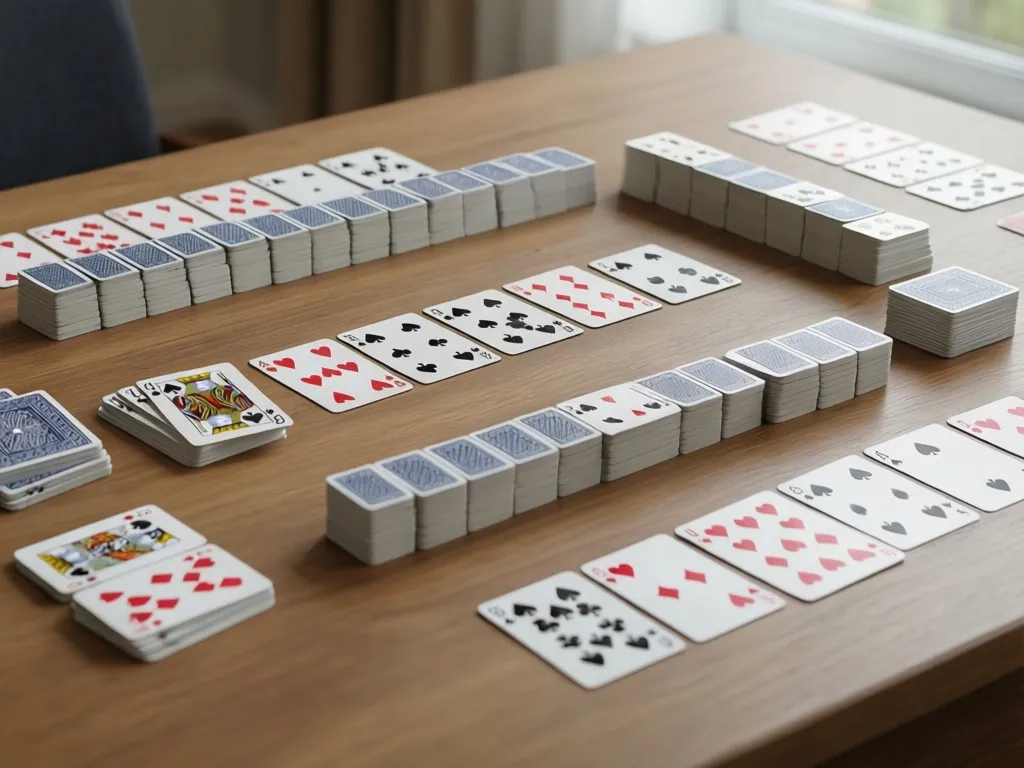
What makes FreeCell deal 617 worth studying
Deal 617 is a representative example of the standard Microsoft FreeCell open-card layout. Its value lies in illustrating common blockers—like a blocked ace or a long sequence trapped behind a single card—and showing how disciplined use of four free cells can unlock a clean path to the foundations. By studying 617, you train the eye to spot forced moves, anticipate cascades, and balance tempo between freeing blocks and advancing foundations. This in-depth look equips you with a repeatable framework you can apply to other deals in the FreeCell category on Solitaire Compass.
Read also: Microsoft FreeCell Original Game History: From Alfille to Windows
Understanding the official setup and rules
FreeCell uses eight tableau columns, four free cells, and four foundations. You move cards to foundations in each suit from Ace to King. Cards in the tableau may be moved to form alternating color sequences in descending order, and you can move either a single card or a valid contiguous stack from a column to another column or to a free cell, provided the move respects the game’s order rules. The four free cells are your temporary holding spaces; strategic placement there can break stalemates and reveal new paths to the foundations. In practice, the key is to maximize moves that unlock multiple cards while keeping flexibility for upcoming turns.
When tackling deal 617, remember that every move should aim to uncover at least one new playable card (especially an Ace or a Two) and preserve at least one free cell for critical forks later in the game. The open-card layout means you should constantly reassess which column holds the best long-term sequence and which card to release next to avoid creating an unresolvable blockage.
Step-by-step solution approach for deal 617
The following approach is designed to be practical rather than theoretical. Adapt it to your exact card arrangement, but keep the core principles in mind: open blockers, funnel cards into foundations when safe, and conserve flexibility in free cells.
- Assess the board and identify any exposed Aces. Move any available Ace to its foundation as soon as it’s safe to do so without blocking future moves.
- Look for a low card (2, 3) in a column that, if moved, would reveal another Ace or a usable sequence. If such a card is not readily movable, use a free cell to unblock it, but plan how to recover that card later.
- Create a space by emptying a column when possible. An empty column can host a long descending sequence, which dramatically improves future options.
- Shift sequences carefully: when you have a choice between moving a single card or a short sequence, prefer the move that reveals more playable cards in the next two turns.
- Advance foundations in tandem with freeing the tableau. Do not delay a move that pushes an Ace or Two into the foundations if it does not compromise later plays.
Concrete move example (illustrative)
Suppose Aces of two suits are exposed. Move A♣ and A♦ to foundations immediately. If a 2♣ sits behind a blocker that also prevents a King from moving, use one free cell to park a mid-range card temporarily, freeing the 2♣ to foundation soon after. Use the freed column to build a short descending run that leads to an empty column, then slide a larger sequence into place. The exact sequence will depend on your layout, but the pattern remains: free blockers, advance foundations, then reorganize for a longer cascade.
Note: FreeCell deals are not unique in their optimal path. The objective is to keep the foundations flowing and to avoid dead ends caused by over-committing to a single column or exhausting all free cells prematurely.
Key decision criteria for dominant strategies
- Foundations first: whenever an exposed Ace or low card can go to the foundations safely, do it to maximize future options.
- Sequence management: prefer moves that unlock multiple cards and enable longer sequences in subsequent turns.
- Free-cell discipline: maintain at least one free cell for critical forks; avoid filling all four with non-essential cards early.
- Column emptiness as a lever: creating an empty column often unlocks the most valuable long sequences and dramatically shifts the game’s trajectory.
Common pitfalls and how to avoid them
- Filling a free cell with a mid-range card that will be needed later; this can block an essential move down the line.
- Locking yourself into a single column’s path instead of considering alternative routes that could reveal hidden options.
- Rushing moves without predicting two steps ahead; always test a backup plan before committing a sequence.
Practice plan and tools
To build skill for deal 617, adopt a deliberate practice routine that mirrors competition-ready play:
- Warm-up: five minutes dedicated to freeing Aces and improving foundation flow.
- Core drill: solve a focused subset of columns in deal 617 for 15 minutes, recording time and success rate.
- Review: after each session, annotate blockers encountered and how you would alter the sequence to improve efficiency.
- Progress tracking: maintain a simple log of wins, time-to-solve, and recurring blockers to quantify improvement over multiple sessions.
FAQ
Is FreeCell deal 617 solvable?
Yes. Deal 617 is solvable with disciplined sequencing and proper use of the four free cells. If you stall, back up to the last safe move and reassess early steps that freed blockers.
What is the best first move for deal 617?
Typically, exposing and moving an Ace to its foundation is a strong start. If no Ace is available, aim to free a card that unlocks a larger sequence or reveals another Ace or Two.
Can I solve 617 without exhausting all free cells?
Often yes. Use free cells to unblock critical cards and replenish them by moving cards back to the tableau when safe. The goal is to minimize free-cell usage while maintaining flexibility for forks.